The game I saw in my head
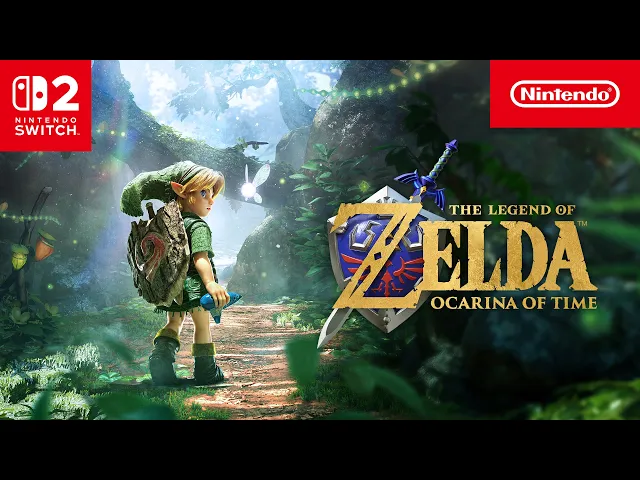
The Ocarina of Time footage Nintendo put out today looks alarmingly like the game I have been describing to people for 28 years rather than the game I played.
Some of that is straightforward. The shops and front rooms in Kokiri Forest, the Castle Town market, the houses in Kakariko: those were never 3D spaces. They were pre-rendered flat images the N64 could hold in memory, with Link and a few pots and villagers composited on top and the camera bolted down so the illusion held. Not rooms so much as photographs of rooms you could walk about inside.
The remake takes the camera off its mount. Link gets a jump button, and he can dive without stopping to put the Iron Boots on. Eiji Aonuma’s phrase for all this is “a faithful interpretation using modern technologies”.
What it does not do is remove the loading screens. Those have been kept deliberately, to preserve something of how the original felt. Or so that’s what they say.
I have been turning that pair of decisions over. A loading screen was always legible as a limit: you knew you were waiting for a machine. The fixed camera was not. It read as a place. So the fidelity here is selective, and the selection runs a particular way: they have preserved the constraint you always noticed and removed the one you never did.
Which is why what is being restored feels like the inference rather than the artefact. In 1998 the machine offered a suggestion of a place and you supplied the rest — the market square behind the camera, the depth the flat image implied, the ledge you assumed you could reach if the game would only let you. Nintendo has now built the version the player’s imagination supplied and given it a price.
Svetlana Boym’s useful line about restorative nostalgia is that it does not think of itself as nostalgia at all, but as truth and tradition. That is the register of the definitive edition, the original mix, the remaster sold as the correction of an error. You have been hearing it wrong; here is what it actually was. This makes a warmer claim than that. It says the memory was right.
The objection, and it is a real one, is that Nintendo needn’t have gone anywhere near my memory to end up here. A free camera is simply how Zelda games are built now, after Breath of the Wild. If the resemblance is a coincidence, it is a coincidence with a cause: a child wondering what was behind the flat wall and a designer with hardware that can finally draw it are answering the same question. Take the limits off and you tend to arrive somewhere similar, whoever you were aiming at. From a trailer I cannot tell the two apart.
There is one useful comparison. A modder called Reonu has spent about a year rebuilding the same pre-rendered areas as real geometry, running on original N64 hardware, and announced it on 16 August, three weeks before the Direct. He has made the opposite choices. The loading screens between the market areas are gone, and the original fixed camera angles are offered as an option. Same game, same operation, reversed judgement about which seams are worth keeping, and only one of the two parties owns anything.
None of that explains the date. Ocarina of Time has come back eight times since November 1998. Master Quest on the GameCube in 2002, the Collector’s Edition in 2003, the iQue Player in China the same year, Wii Virtual Console in 2007, the 3DS remake in 2011, Wii U in 2015, the Switch Online N64 library in 2021, and now Switch 2 on 5 November. Eight returns in 28 years, and the longest it has ever been out of reach is about six.
Every one of those lands on a new machine or a new storefront. None of them lands on a round anniversary—the remake is part of the broader 40th anniversary celebrations for the original Famicom release. Whatever is going on in me while I watch a trailer, the rhythm of the thing belongs to the hardware: the game comes back when a console needs a library, and the Switch 2 needs a library. So 28 years is a measure of how long I have been worth selling to rather than of how long the game was gone.
I will buy it on 5 November. The version I have been carrying since 1998 has had all those years to improve without supervision, and I am curious which of us got it closer.